

 Sarah Hermes Griesbach
 New Jersey’s naming is a classic tale of 17th-century political favors and colonial real estate. While the primary reason for our great state’s name is well-documented, there are quite a few fun parallels that link the third state to ratify the U.S. Constitution and its island eponym. Read on to learn about New Jersey’s naming origins as well as the historical, geographical, and serendipitous connections between the old Jersey of England and the U.S. Garden State.
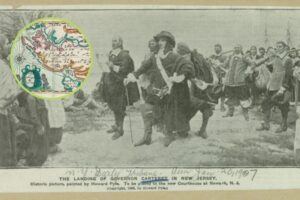
Photo Credit: New York Public Library
We Could Have Been New Netherland
Before the British took over this region, the Dutch referred to the place we now call New Jersey as part of Nieuw Nederland or New Netherland. Some early maps and settlers used Dutch nomenclature for the area, like Pavonia or Achilles Kol, but, in 1664, the British Jersey label was enforced by a royal decree.
Read More: The History Behind New Jersey County Names
New Jersey was named by Sir George Carteret and Lord John Berkeley after the Isle of Jersey in the English Channel. The Duke of York, who would later become King James II, granted the territory to Carteret and Berkeley as a reward for their loyalty during the English Civil War. Sir George Carteret had served as the Lieutenant Governor of the Isle of Jersey and had provided a sanctuary for the exiled Charles II. The name New Jersey was both a tribute to Carteret’s ancestral home and a political message made in defense of the Crown.


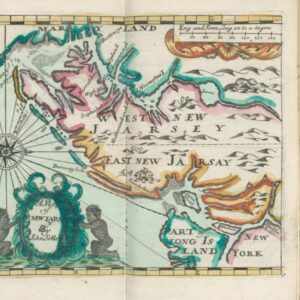
The legal boundaries of the British colony of New Jersey and the number of New Jerseys in the Americas caused significant confusion for decades. For a long period, New Jersey wasn’t one entity. Between 1674 and 1702, it was a colony split between East Jersey and West Jersey due to disputes between the landholding proprietors. The land wasn’t unified into a single royal colony until 1702.
But What is this Place called Really?
Many New Jersey place names come from the Lenape or Delaware language. Today, we employ Lenape-derived names like Hoboken, which comes from Hupokàn meaning pipe, or Weekawken, which comes from Xwiiahkiing, which means place of gulls. The whole region was referred to as Scheyechbi, meaning long land water. These indigenous names typically described the local landscape rather than recognizing a person or people asserting ownership. Scheyechbi referred to the land between the Delaware River and the Atlantic Ocean.
Across the Pond
New Jersey’s Northwestern European namesake is actually more than just a single Jersey and not even part of the United Kingdom. The Isle of Jersey, and the islands of Minquiers and Écréhous make up the Bailiwick of Jersey. The Bailiwick of Jersey is a self-governing British Crown Dependency in the Channel Islands. It is a specific territory under the jurisdiction of a Bailiff, who serves as the civic head, president of the legislature, and head of the judiciary.
The Bailiwick of Jersey, which sits near the coast of northwest France, is separated from the U.S.’s New Jersey by roughly 3,000 nautical miles and by a massive difference in scale, but the two Jerseys share a few surprising commonalities. The history connecting the two locations is rooted in 17th-century political loyalty but has evolved through agriculture and geography in the centuries since then.
We all know that our Jersey is known as the Garden State. Well, old Jersey is famous for its agriculture too, specifically the Jersey Royal potato, which comes from the Americas but is a staple of British cuisine. Both regions have historically relied on their fertile soil as a core part of their identity. Both are roughly at similar latitudes – the island is slightly further north – which contributes to their shared history of seasonal farming. The similarities between the Jerseys range from significant to superficial to spurious.
Quirky Parallels and Competitions
The most famous global export of the Channel Island Jersey is the Jersey cow. The American Jersey Cattle Association notes that the breed was cultivated for nearly 600 years on the Isle before becoming a major part of the U.S. dairy industry. These cows were brought to the United States in the 1800s and have been making our milk ever since. Consequently, the “Jersey cow” is a common sight in the rural parts of the US state that shares its name.
Both the old and the new Jersey are deeply defined by our relationships with the sea. The Isle of Jersey’s dramatic cliffs and gorgeous beaches compete on sure footing with the New Jersey peninsula’s famous coastlines. While New Jersey has its boardwalk oysters, clams, and crab shacks, old Jersey is famous for its spider crabs and ormers (a type of local shellfish). Both cultures revolve around seasonal, ocean-to-table dining. At the moment, the Bailiwick of Jersey has one more Michelin-starred restaurant than the foodie State of New Jersey can claim.
Both Jerseys brag elegant Victorian-style seaside architecture with a clear resemblance between Cape May and the port towns of the Isle of Jersey’s 19th-century resort town aesthetic. As the largest of the Channel Islands, Jersey is a popular holiday destination. The main town of St. Helier is the hub for nightlife, known for cosy traditional pubs and chic cocktail bars. To which the Jersey Shore says, “Hold my bucket of booze.”
Both Jerseys have thriving, dedicated surfing communities. The Isle of Jersey boasts one of the oldest surf clubs in Europe and hosts major surfing competitions. And of course, New Jersey has a robust year-round surfing scene that is often overlooked by outsiders but absolutely central to local life in surftowns like Manasquan and Belmar. If it’s a competition, New Jersey wins, hands down, on size. The Bailiwick consists of the main island of Jersey and some surrounding uninhabited islands and rocks, including Les Dirouilles, Les Écréhous, Les Minquiers, and Les Pierres de Lecq. Those French names are fancy, but New Jersey has the Barrier Islands, Ellis Island, Liberty Island, and a whole lot of notably big rocks.
The Ties That Bind Us
The strongest formal link today is between the two Jersey capitals. Trenton, New Jersey, and Saint Helier, the capital of the Isle of Jersey, are official Sister Cities. This partnership was established to foster cultural and commercial exchange, serving as a modern bridge between the two regions that share a naming history.
Both Jerseys share a love of sports. While the Isle of Jersey is obsessed with cricket and rugby, we all love soccer. The Isle of Jersey calls their soccer football, but we need not hold that against them. Their national football team, the Jersey Bulls, competes in the English league system. The great state of New Jersey is arguably the soccer capital of the U.S., home of the NY/NJ Red Bulls, and hosting the 2026 World Cup!
See More: Montclair Spots That Have Stood the Test of Time
Both Jerseys boast a serious love of golf. The Isle of Jersey produced the legendary Harry Vardon, who won six British Opens. New Jersey is home to some of the most prestigious courses in the United States, like Pine Valley and Baltusrol, and is the headquarters of the USGA. In this area, the Islanders set an example worth following. While traditional golf courses often face criticism for acting as biological dead zones, the Isle of Jersey’s La Moye Golf Course famously protects its fragile coastal environment. Their stunning sand dunes are managed for botanical, historical, and wildlife conservation.
What’s in a Name?
There are a zillion measures by which the Jersey of Europe and the Jersey of North America can be compared. Both have rather business-friendly political structures. Both hold precious biodiversity. Both have gorgeous historic lighthouses. Both the island and the peninsula have a well-documented history of mermaids. The Isle is home to the mythical Black Dog of Bouley Bay; New Jersey has its Devil. The top favorite traditional dessert in the Bailiwick of Jersey is Jersey Wonders or des mèrvelles, which is similar to a doughnut; and the State of New Jersey really, really loves doughnuts.
Perhaps sharing a name doesn’t mean we are destined to be twins, but there is a lot to appreciate in both of the world’s Jerseys. New Jersey and the old Bailiwick have taken wildly different paths over the last few hundred years, evolving into unique places with our own particular quirks and vibes. So, while it’s fun to point out that we both love the ocean and have pretty brown milk cows, our two Jerseys are like two very cool strangers who happen to share the same surname.
Follow @thenewjerseygirl on Instagram + TikTok for the latest updates on Hoboken, Montclair, Bergen County, and more, sign up for our weekly newsletter here that shares everything you missed each week, and check out our events calendar, which has over 100+ events weekly to peruse.