



 stephanie

It’s not unheard of for college roommates to co-found a business, but it’s a bit more unusual when the business involves a Stanford bioengineering professor and a UVA Engineering grad. Gordon Avery is the Northern Virginia native and co-founder of SoftShox, a Vienna-based startup developing technology designed to reduce the force of impacts to the head in sports and recreation. From bicycle helmets for children to protective gear for equestrians and skiers, SoftShox is working to rethink how safety equipment protects the human body. The Fairfax Girl chatted with Gordon at, where else but the Vienna Inn, to learn more about the company, its Northern Virginia roots, and what to be on the lookout for from SoftShox. Read on for more about SoftShox, a Vienna-based company with big goals for safety.

Origin Story
Gordon Avery is a Northern Virginia native and a graduate of Thomas Jefferson High School for Science and Technology. He played football there and went on to play in college at Princeton. “My football career was ended by a concussion in college,” Gordon said. Gordon went on to earn degrees from the University of Virginia (ME) and an MBA from the Darden Graduate School of Business and he grew his career. Over the years, he kept in touch with former teammates and friends from college. One in particular, Dr. David Camarillo, had gone on to Stanford University and was working in bioengineering.
Read more: Vienna’s Clarity Opens Second Location in Reston (+ We Got an Early Look)
Gordon was visiting David in California in 2022, and the two got to talking about the research in David’s lab. “It just kind of started with friends catching up, and about personal and professional things,” Gordon said. The two believed the technology was advanced enough to move beyond the laboratory and address a significant problem in sports safety. “We believed we could build a successful business around it, but there’s also a little bit of a personal passion as well,” Gordon said. “The work in David’s lab, studying brain injuries, is where the core technology was originally developed.”
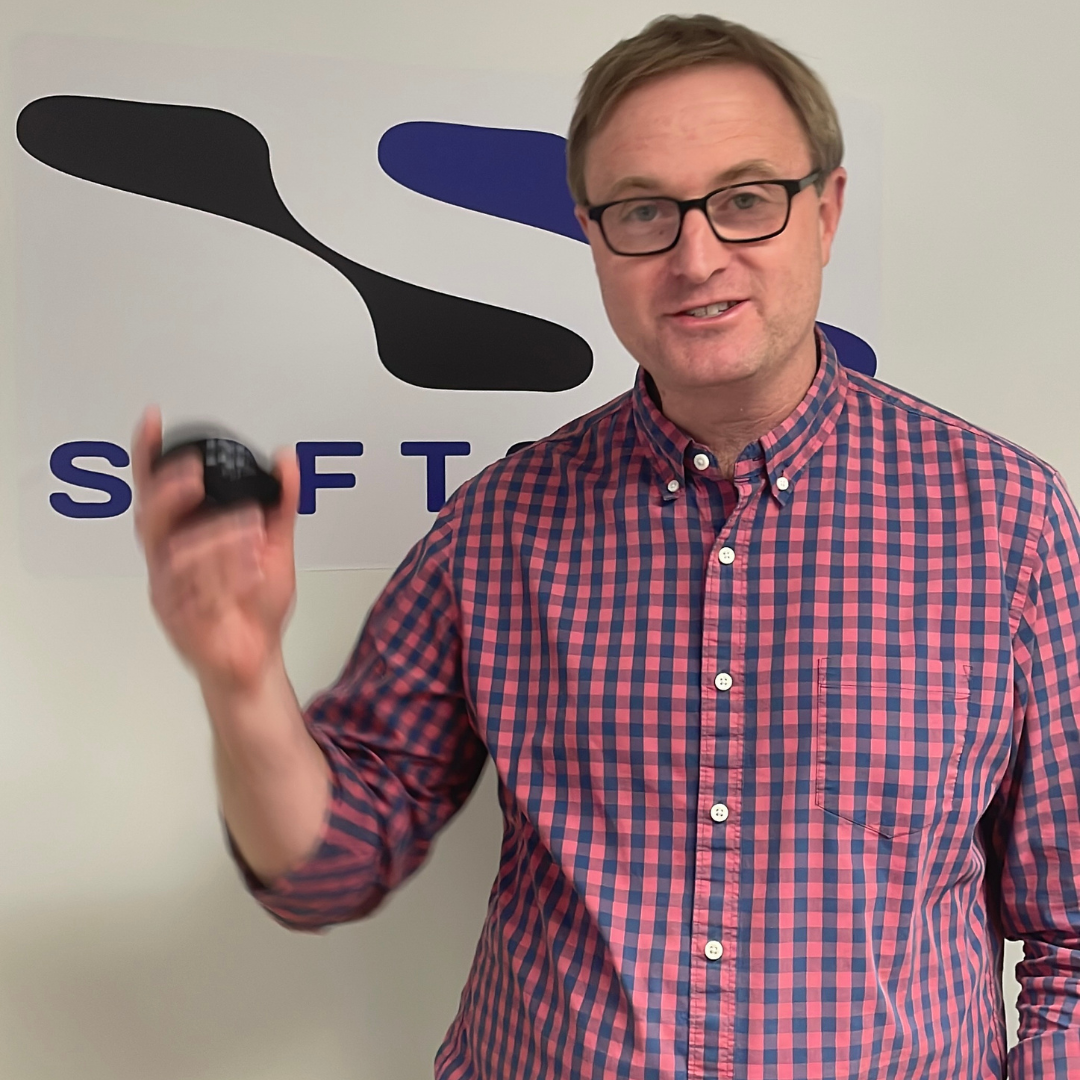

They initially raised a small round of funding from friends and family while applying for grants from the National Institutes of Health. “Eventually we won a very large NIH grant that has been incredibly transformative for us and allowed me to hire the team, build the team,” Gordon said.
The SoftShox office is in Vienna, just steps away from the W+OD Trail. Gordon said that keeping the company in Northern Virginia made a lot of sense. “There are so many great universities nearby, and that means access to specialized engineering talent,” he said. “Virginia Tech’s Helmet Lab is a great resource; they do a lot of research and testing on protective equipment, and one of our engineers worked there in college.”
Solving for Safety
Most people assume that wearing a helmet means they’re protected from serious head injuries. While helmets are essential safety equipment, preventing concussions remains a complicated challenge. Traditional helmets generally use foam padding to absorb energy during an impact. But those materials don’t necessarily respond equally well to every type of collision, particularly lower-intensity impacts.
SoftShox is working on an alternative using patented hydraulic technology that can respond to different levels of force. The technology uses small, liquid-filled shock absorbers that can be incorporated into protective equipment. The concept is similar to hydraulic systems used in automobiles, but adapted into lightweight, wearable padding.
Its first major commercial product is a football chinstrap developed in partnership with Guardian Sports, the company behind the Guardian Cap helmet covers. The Guardian SoftShox Chinstrap is designed to reduce the force transmitted to a football player’s head when the facemask is struck. “Half of the impacts to the head of a football player are to the facemask, and it is notoriously one of the least well-performing impact locations,” Gordon said.
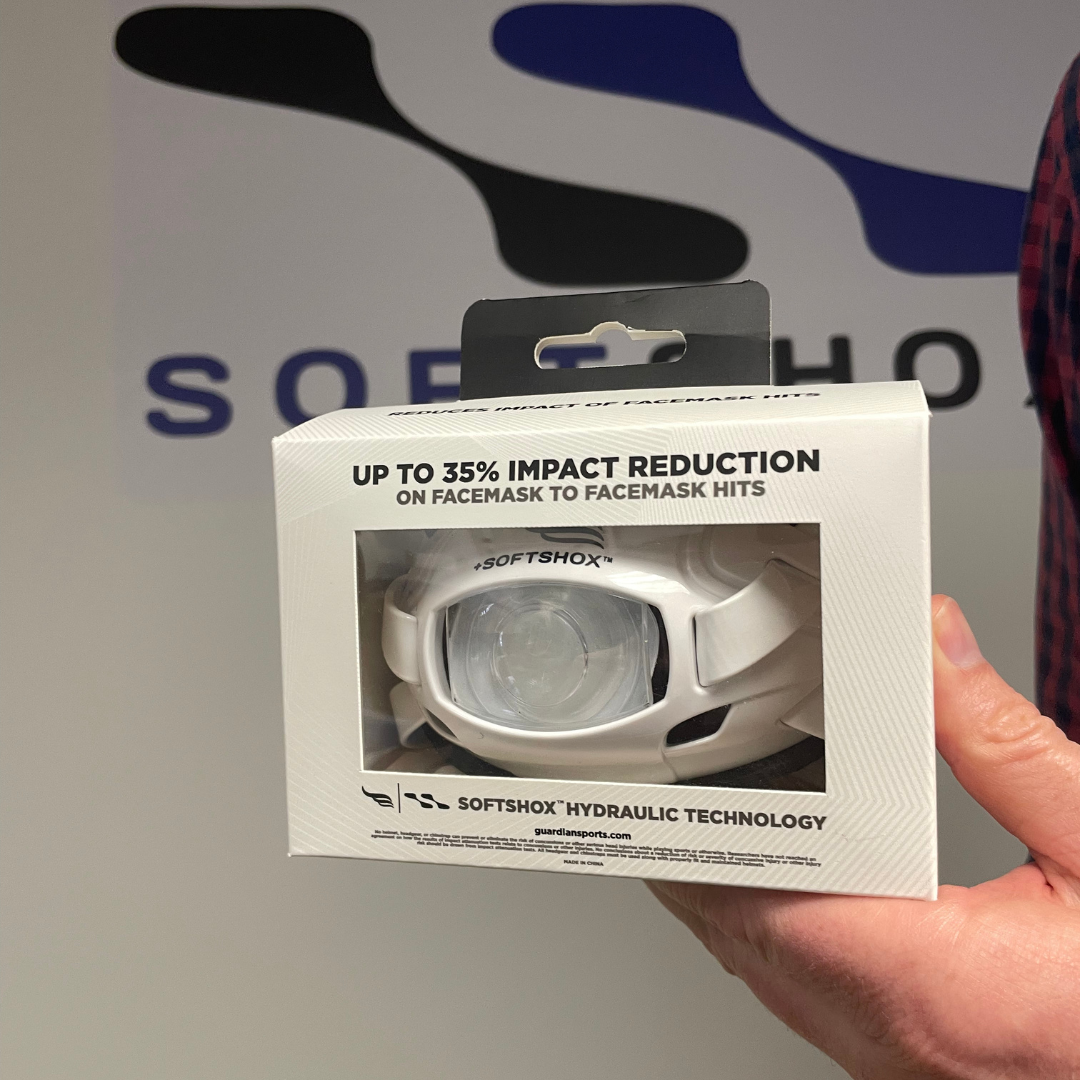
According to the company, laboratory testing has shown that the technology can reduce measured impact forces by approximately one-third under specific conditions. Those results do not establish an equivalent reduction in concussion risk, but they suggest the technology could improve protection in an area of football equipment that has historically been difficult to address.
“By putting our technology into the chinstrap, it cuts the forces by a third,” Gordon said. “We test it against all the other chinstraps, and none of them do anything close to what we’re talking about.” The product is currently available for purchase online, and Avery told The Fairfax Girl that it is expected to become available at Dick’s Sporting Goods in 2027.
SoftShox is also developing applications for lacrosse, cycling, and equestrian sports, as the company looks to bring its technology beyond professional football. “We’re working actively in football, lacrosse, cycling, and equestrian, because there’s a lot of traumatic brain injury out there,” Gordon said.
A Bigger Goal: Affordable Bicycle Helmets for Kids
One of Gordon’s biggest ambitions has nothing to do with professional football. He wants to develop an affordable bicycle helmet for children that incorporates SoftShox’s technology. “The [safety] standards have not kept up with the pace of scientific inquiry and knowledge,” he said. He believes researchers are continuing to learn more about how the brain responds to smaller impacts and repeated injuries over time. That research, he said, should influence how protective equipment is designed.
Traditional bicycle helmets have historically focused on preventing skull fractures during severe collisions. While they provide essential protection and should always be worn, Gordon believes more can be done to address concussions that occur during lower- and medium-intensity impacts. “Bike helmets today are built to prevent skull fracture, not to prevent concussion,” Gordon said. He explained that conventional helmet foams are often designed to crush under significant force, helping protect against catastrophic injuries, but may be less responsive during smaller impacts.
See more: Fairfax County Is Saying Goodbye to Pennies for Some Cash Payments
SoftShox hopes to use its hydraulic technology to address some of those limitations. Creating safer equipment is only part of the challenge: making it affordable is equally important. When companies introduce new helmet technology, it often appears first in expensive, premium products. “A lot of times what they’ll do is they’ll take a technology like ours and introduce it at a premium price point,” Gordon said. That approach can leave families unable to access newer safety features, particularly when children need replacement helmets as they grow.
View this post on Instagram
Gordon wants SoftShox to develop a children’s bicycle helmet that combines improved protection with an accessible price. “One of the things I really want to do is build a kid’s bike helmet that’s affordable,” he said. The company has discussed potentially launching a crowdfunding campaign to gauge demand and help fund production. The project remains in the planning stages, and the company has not announced a launch date. “We would make it in America, we would make it the safest bike helmet that we believe we could create, and it would be at an affordable price point,” Gordon said.
Follow @thefairfaxgirl on Instagram + TikTok for the latest Northern Virginia updates, and check out our events calendar, which has over 100+ events weekly to peruse. Sign up for our newsletter here.